What the show stages
The history behind the show
The people and turning points behind El Sueño de Toledo: Recaredo, al-Mamun, Las Navas de Tolosa, Isabella, Charles V and the railway, with dates.
Choose a date for the night show ↗Quick answer
El Sueño de Toledo covers about 1,500 years of Spanish history, from the Visigothic king Recaredo to the arrival of the railway. The park and the ticket name Recaredo, Taifa King al-Mamun, the battle of Las Navas de Tolosa, Queen Isabella, the voyage to the Americas and Emperor Charles V. This guide gives the dates and context for each, so the stage story makes sense.
A frame of fifteen centuries
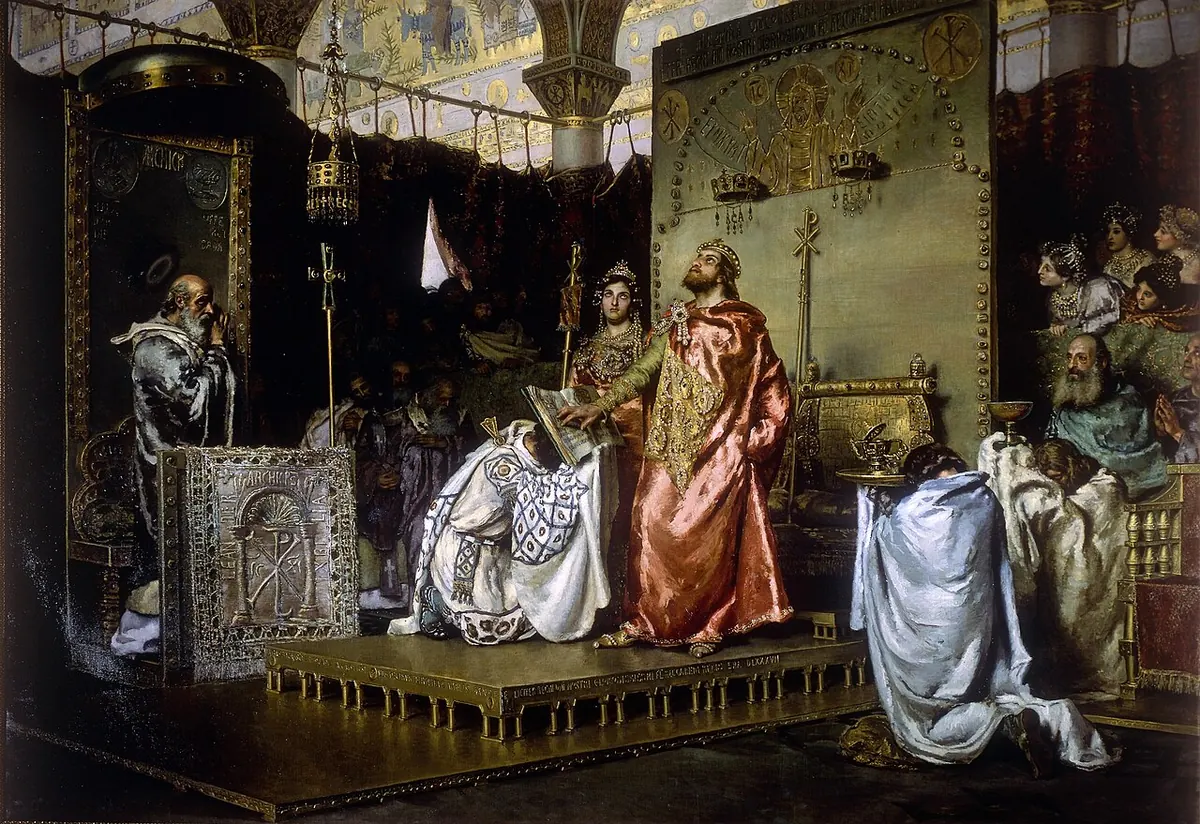
The park describes the show as a historical fresco that runs from the reign of Recaredo to the arrival of the railway. A young washerwoman, María, meets the old Azacán of Toledo beside the Tagus at sunset, and he takes her back through time. That device lets the show jump between periods without a lecture. The park lists the show under its night-show heading, separate from the daytime shows, and labels it for families. You do not need the dates to enjoy it, but they explain why Toledo is the right city for the story.
Recaredo and Visigothic Toledo
Visigothic rulers made Toledo their capital in the middle of the sixth century. Recaredo reigned from 586 to 601, and Toledo was his capital as it had been his father's. In 587 he renounced Arianism for Chalcedonian Christianity, and the Third Council of Toledo met in his name in May 589. That is why the story starts here: it is the moment Toledo first matters to the whole peninsula. The Visigothic period is also the setting of El Misterio de Sorbaces, one of the park's daytime shows.
Al-Mamun and the taifa of Toledo
In 1018 Ismail expelled the governor of Toledo and the city became independent in practice, the centre of its own taifa kingdom. Al-Mamun first asked Ferdinand I of León and Castile for help against the taifa of Zaragoza. He ruled from 1043 to 1075, annexed Valencia in 1064 and took Córdoba in 1075 with help from Alfonso VI. He was poisoned the same year. Arabic was the state language, and Muslims, Christians and Jews lived in the city. The taifa ended when Toledo passed peacefully to Alfonso VI in 1085.
Las Navas de Tolosa, 1212
On 16 July 1212, near Las Navas de Tolosa in the province of Jaén, a Christian coalition under Alfonso VIII of Castile, with Peter II of Aragon and Sancho VII of Navarre, defeated the Almohad caliph Muhammad al-Nasir. Templar squadrons, Crusaders and Leonese volunteers fought alongside the kings. It is described as a turning point of the Reconquista. Baeza and Úbeda fell soon after, and the conquests of Córdoba, Jaén and Seville followed in 1236, 1246 and 1248.
Isabella and 1492
Isabella was crowned Queen of Castile on 13 December 1474 and reigned until 1504. She married Ferdinand in 1469, and in January 1492 she and Ferdinand received the keys of Granada. Columbus sailed that August, reaching the Caribbean on 12 October 1492. The ticket describes the show's voyage into the Americas, which is the point where the story leaves the peninsula. Her reign with Ferdinand is where Spanish history turns outward, and the Americas chapter belongs to that era.
Charles V, and the court that left
Charles was proclaimed King of Castile and Aragon in 1516 and won the imperial crown in 1519. After the revolt of the Comuneros was crushed, his court was installed in Toledo, and from 1525 he chose the city as his residence at least fifteen times. In 1561 the royal court moved to Madrid, and Toledo entered a slow decline. The park names Charles V among the figures on stage. He died in 1558 at the Monastery of Yuste, two years after his Spanish reign ended.
Who this isn't for
If you want a documented, footnoted account of these centuries, the show is the wrong tool. It is a spectacle with horses, dancers and projections, and the park decides how each chapter is staged. The park decides how long each chapter lasts. Read this page, a good history of Spain or the pages linked below if you want the facts in order, and see the show for the atmosphere.
Read next: Toledo before the night show
Frequently asked questions
Which periods does the show cover?
About 1,500 years, from the reign of Recaredo to the arrival of the railway. The ticket names the battle of Las Navas de Tolosa and the voyage into the Americas.
Do I need to know Spanish history?
No. The story is all-visual and told through a young woman and an old water carrier travelling through time.
Is the show accurate history?
It is a spectacle built on real events and people, so treat it as a dramatised overview, not a lecture.
Sources